3 MIN READ
Deck & Patio
Written By
G2G Team
Published
May 22, 2026
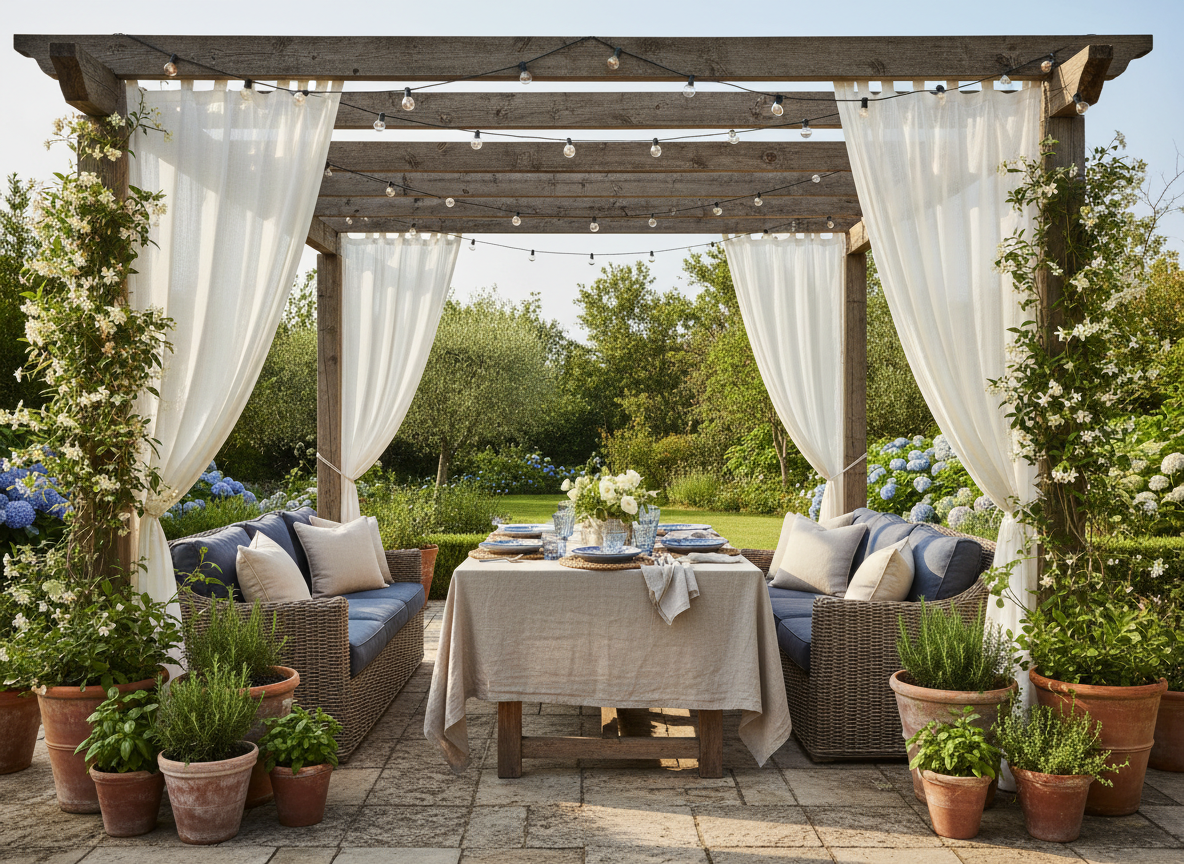
The moment you step under a well-decorated pergola, something shifts. The air feels cooler, filtered through climbing wisteria or the lacy canopy of a grapevine, and the light lands in soft, shifting patches across the floor. There is a particular ease that settles over you in that space — the outdoor world stays in view, but the structure creates just enough enclosure to feel like a room. That tension between open and sheltered is precisely what makes pergolas one of the most versatile and rewarding outdoor structures in garden design.
The trouble is that most pergolas are under-decorated. The bare beams go up, a couple of chairs appear below, and the space never quite becomes the destination it was meant to be. Great pergola decorating is not about filling every surface; it is about building atmosphere in layers. Start with light — how it falls during the day and how you create it at night. Layer in softness with textiles, then add greenery to blur the line between structure and garden, and finally choose furniture that tells people to sit down and stay.
Whether you are working with a classic cedar-beam structure draped in climbing roses, a powder-coated steel frame with a contemporary edge, or a budget-friendly DIY build in need of a personality, these 19 pergola decorating ideas cover every aesthetic. You will find Mediterranean courtyard warmth alongside Japandi restraint, cottage garden abundance beside modern entertaining setups. If you are still choosing the right structure to decorate, our guide to pergola ideas for shaded outdoor entertaining is the natural place to start. Pick the combinations that feel like the outdoor space you have always wanted to use — not just admire from the window.
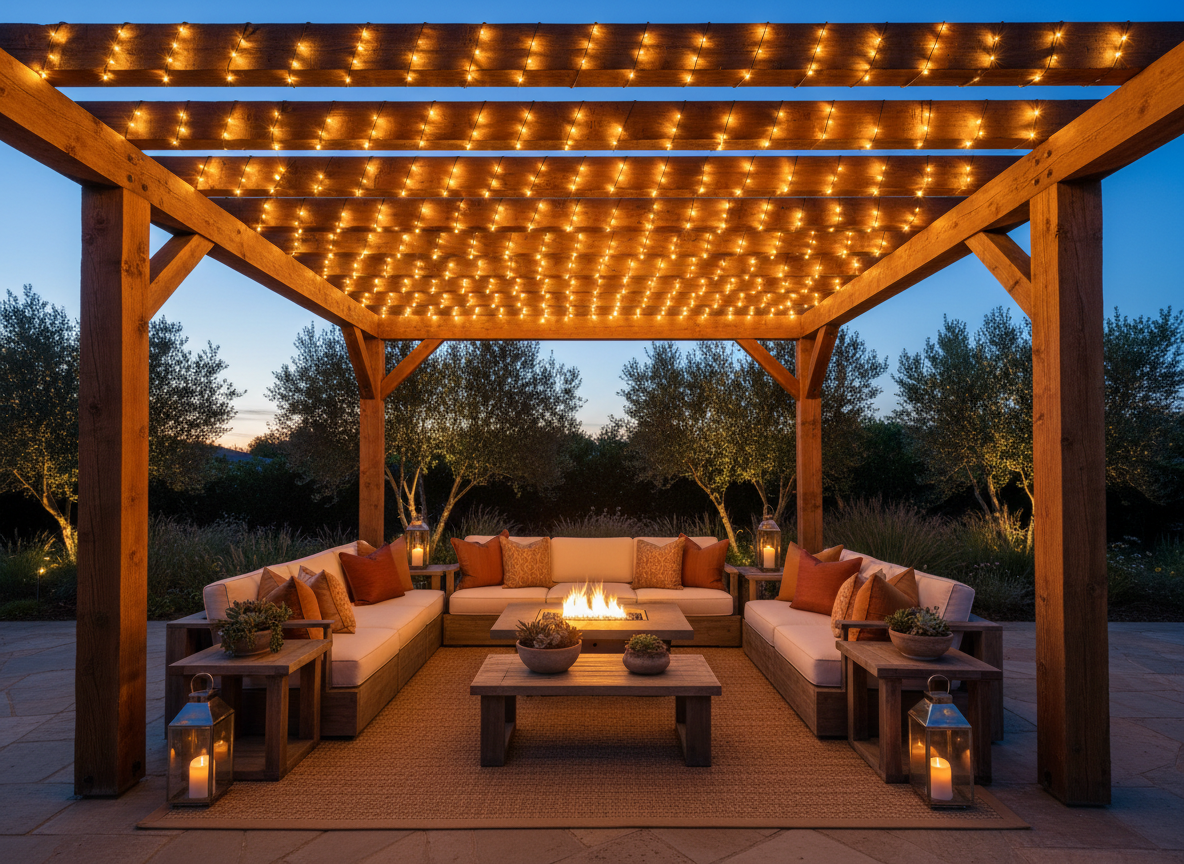
There is nothing that transforms an outdoor space after dark quite as reliably as well-placed string lights. Wrapped tightly around pergola beams — following the structural lines of the frame — warm-white Edison bulbs create a glow that feels architectural rather than purely decorative. The trick is intentionality: instead of draping them loosely overhead in a single swag, wind the cable around each beam post from base to top, then run parallel lines across the ceiling at even intervals of roughly eight inches. The result is a lit ceiling that mimics the warmth of candlelight at scale, turning a darkened garden into a room you can see and feel.
For the best effect, choose filament-style bulbs with a colour temperature of 2,200K to 2,700K — this is the amber end of the spectrum that flatters skin tones, timber finishes, and food equally. Weatherproof LED string lights rated IP44 or higher handle moisture without flickering or degrading. Solar-powered options have improved dramatically and work well in pergolas that receive good afternoon sun, eliminating the need for an outdoor power source entirely. A dimmer switch — either smart or analogue — completes the setup and lets you shift from bright enough for a dinner party to barely-there ambient glow for a quiet evening with a glass of wine.
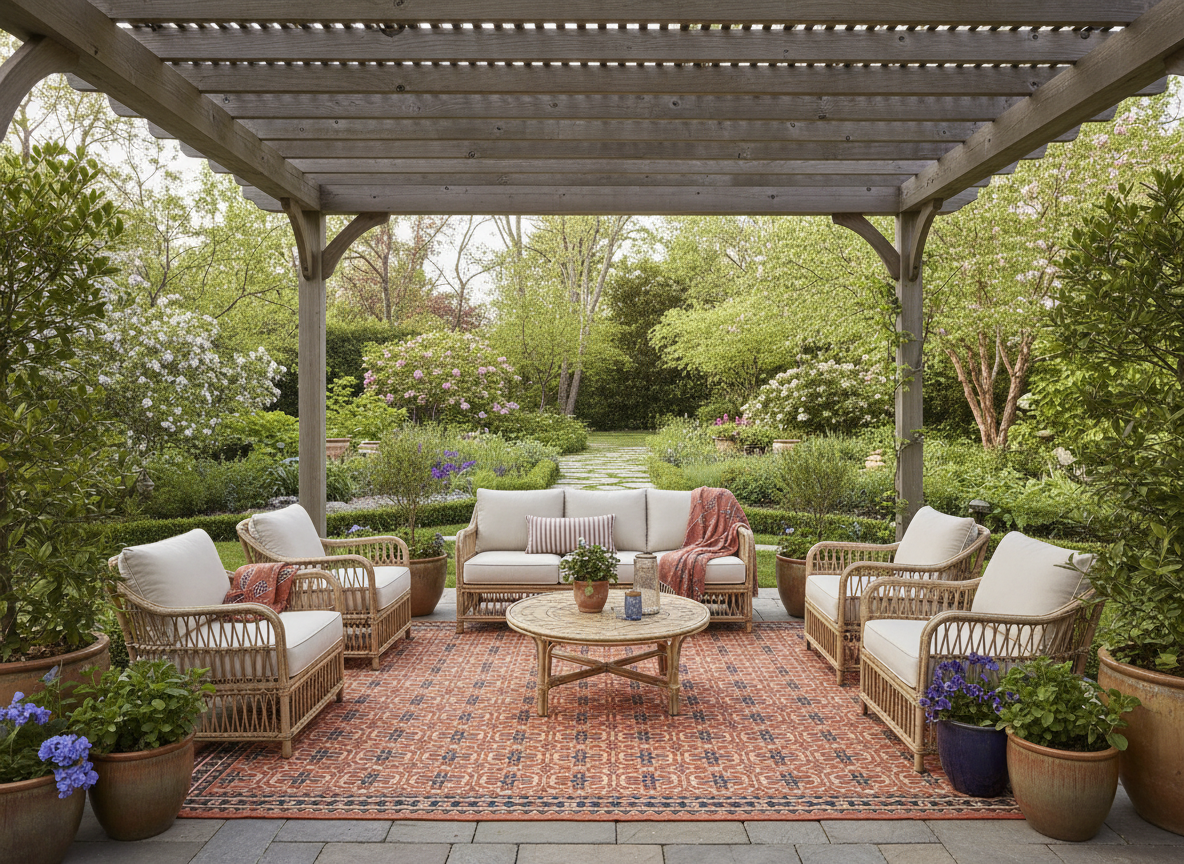
A pergola without a rug is like a living room without a floor — the furniture floats, the space feels unresolved, and guests instinctively do not know where to gather. Laying a large outdoor rug beneath the seating group creates a psychological boundary that says this is the room. It grounds the furniture, softens the hard surface underfoot, and adds the first layer of warmth to the overall aesthetic.
For pergola use, polypropylene rugs are the material of choice: they resist UV fading, tolerate rain and humidity without moulding, and clean up with a garden hose. Choose a rug that extends at least 18 inches beyond the front legs of your seating on all sides — a common mistake is buying too small, which makes the furniture look perched rather than placed. Bold geometric or botanical patterns hold their visual weight outdoors far better than they would inside, where they might feel overwhelming. In a neutral-toned pergola with timber or white-painted beams, a richly patterned rug in terracotta, indigo, or sage green can function as the space’s single strongest piece of artwork — setting the colour story for everything placed above it.
There is a specific kind of beauty that emerges when structure and plant become indistinguishable from each other — when the climbing wisteria has been given years to wrap every beam in gnarled silver-grey bark and, in late spring, erupts in hanging clusters of lilac bloom that perfume the air beneath. This is the most romantic version of pergola decorating, and it requires patience more than budget.
Star jasmine (Trachelospermum jasminoides) is the practical choice for reliable performance: it grows quickly, stays evergreen in mild climates, and produces small white flowers in summer that scent the air in a way no candle can replicate. Wisteria is the more spectacular option but demands a structurally sound pergola — the mature weight of an established vine is considerable, and lightweight builds struggle to support it. For both climbers, fix galvanised training wires or vine eyes to the upright posts and run them horizontally every 12 inches to give the plant something to grip. According to the Royal Horticultural Society, regular late-summer pruning keeps climbing plants in check and encourages prolific flowering rather than leafy overgrowth — cutting back the summer whippy shoots to around five leaves achieves this in minutes.

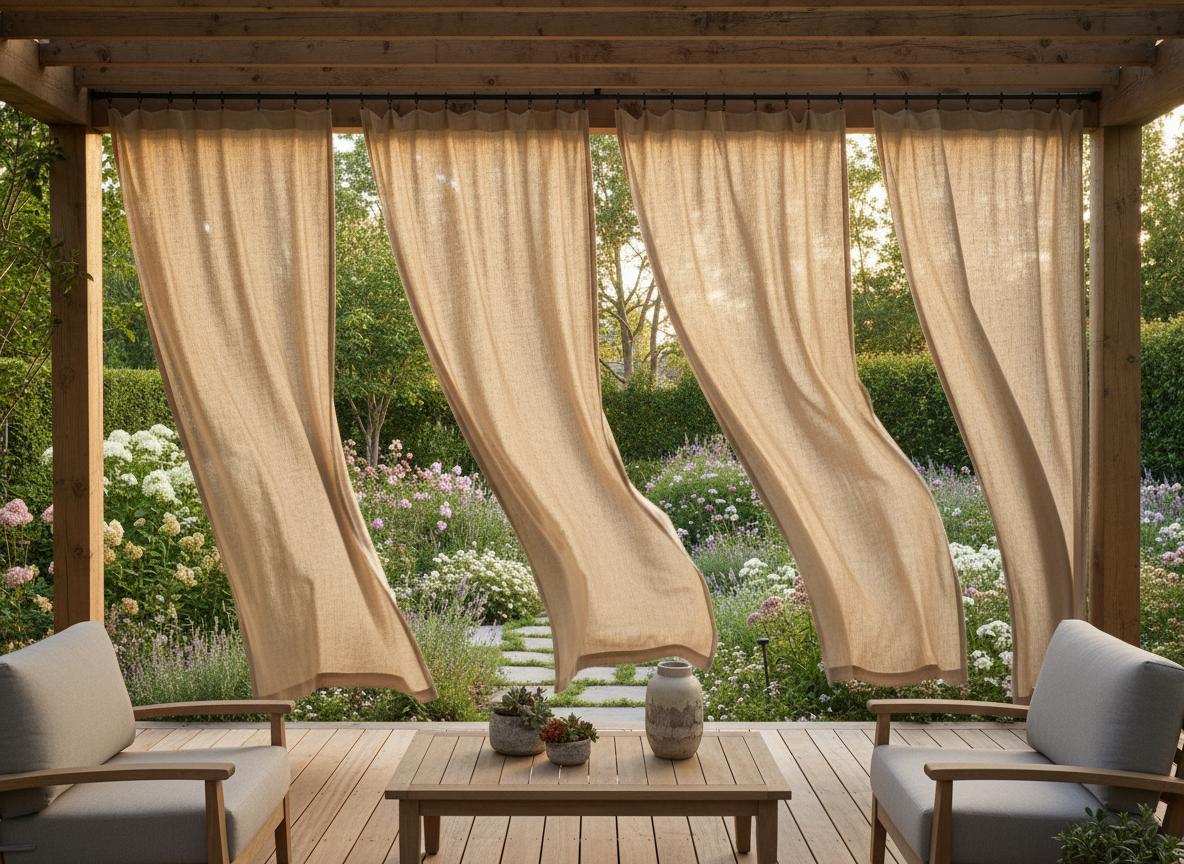
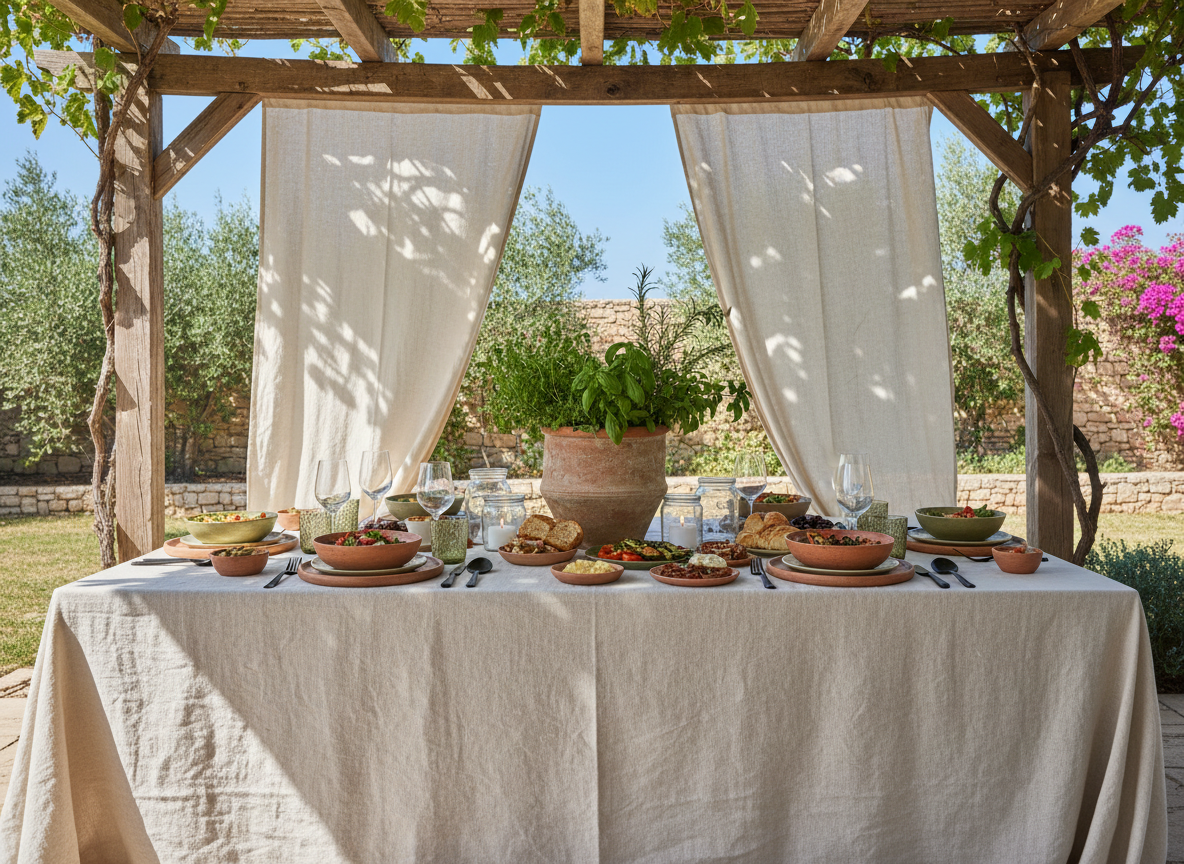
Pergola curtains accomplish two things simultaneously: they create a sense of enclosure when drawn and make the space feel dramatically airier when pushed back to the posts. This is the decorator’s trick for transforming a pergola from a structure you happen to sit under into a genuine outdoor room with edges. Hung from ceiling-mounted curtain tracks or tensioned stainless steel wire, full-length panels in natural linen or solution-dyed canvas soften the entire perimeter of the space.
For colour, stay close to nature: warm whites, stone grey, terracotta, sage, or sand. These tones hold beautifully under outdoor light and complement almost every furniture choice. Avoid heavy blackout linings outdoors — the appeal of these curtains is their movement in a breeze, the way soft light filters through the weave in the afternoon. Use marine-grade stainless steel hardware for the curtain rings, tracks, and fixings to prevent rust staining on the fabric over time. Weigh the hem with a discreet horizontal rod or sewn-in lead weights to stop the panels billowing and tangling on gusty days. When drawn, they also cut wind chill noticeably, which can extend the usability of your pergola well into cooler autumn evenings.
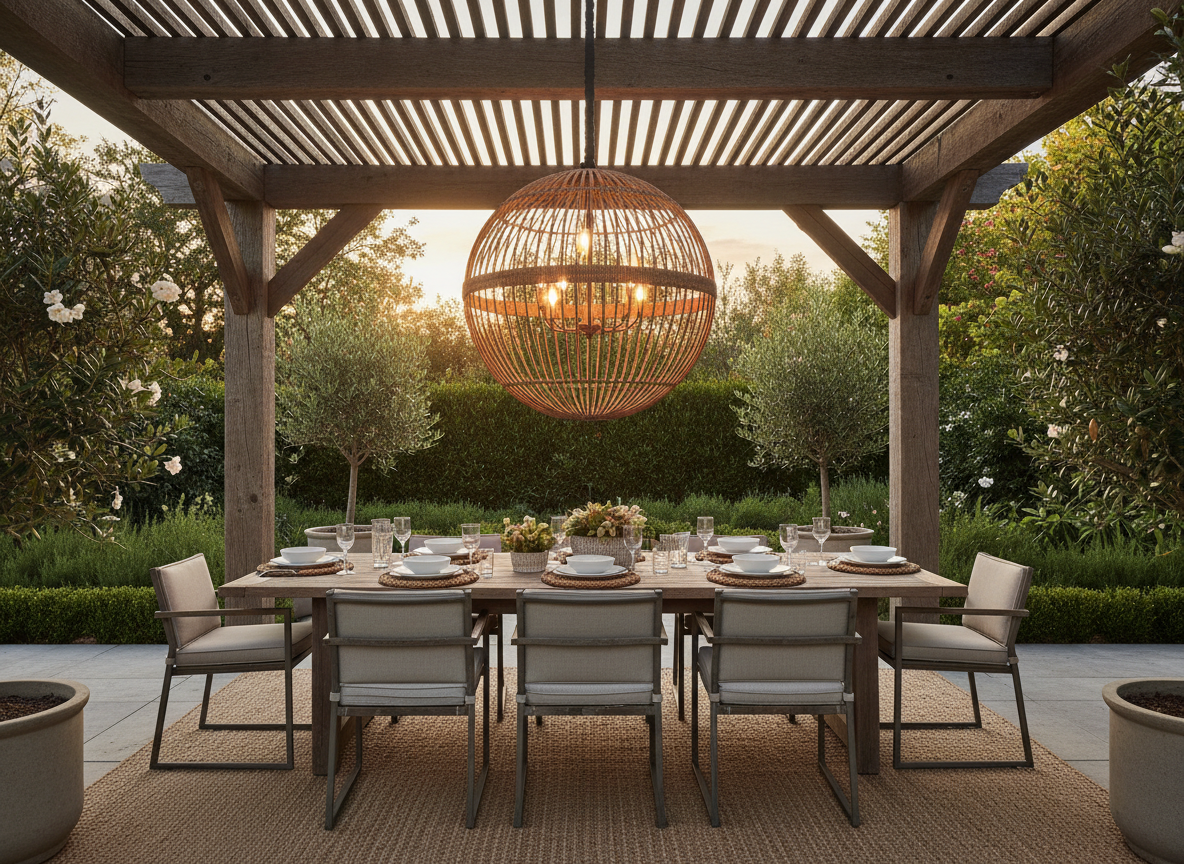
The vertical centre of a pergola — the point directly overhead when seated at the table — is often left entirely empty, and filling it with a statement pendant light changes the spatial experience in a fundamental way. An outdoor chandelier, whether a large rattan globe, an iron multi-arm design fitted with Edison bulbs, or a woven bamboo pendant, creates a focal point that visually organises the space beneath it. When guests arrive in the evening, the eye is drawn upward, and the fixture frames the room the way a ceiling rose frames a formal dining room indoors.
For wiring, a weather-rated pendant on a hardwired drop from the beam is the cleanest solution, but a large, well-made battery-operated chandelier hung from a carabiner makes this look achievable without an electrician. Look for IP44-rated fittings or higher for open-sided pergolas. Scale is everything outdoors: a fixture that would feel generous in an interior dining room is usually visually too small once it is competing with a garden backdrop. For a table seating eight, a pendant with a minimum 60cm diameter gives the visual weight the space needs without overwhelming the view beyond the frame.
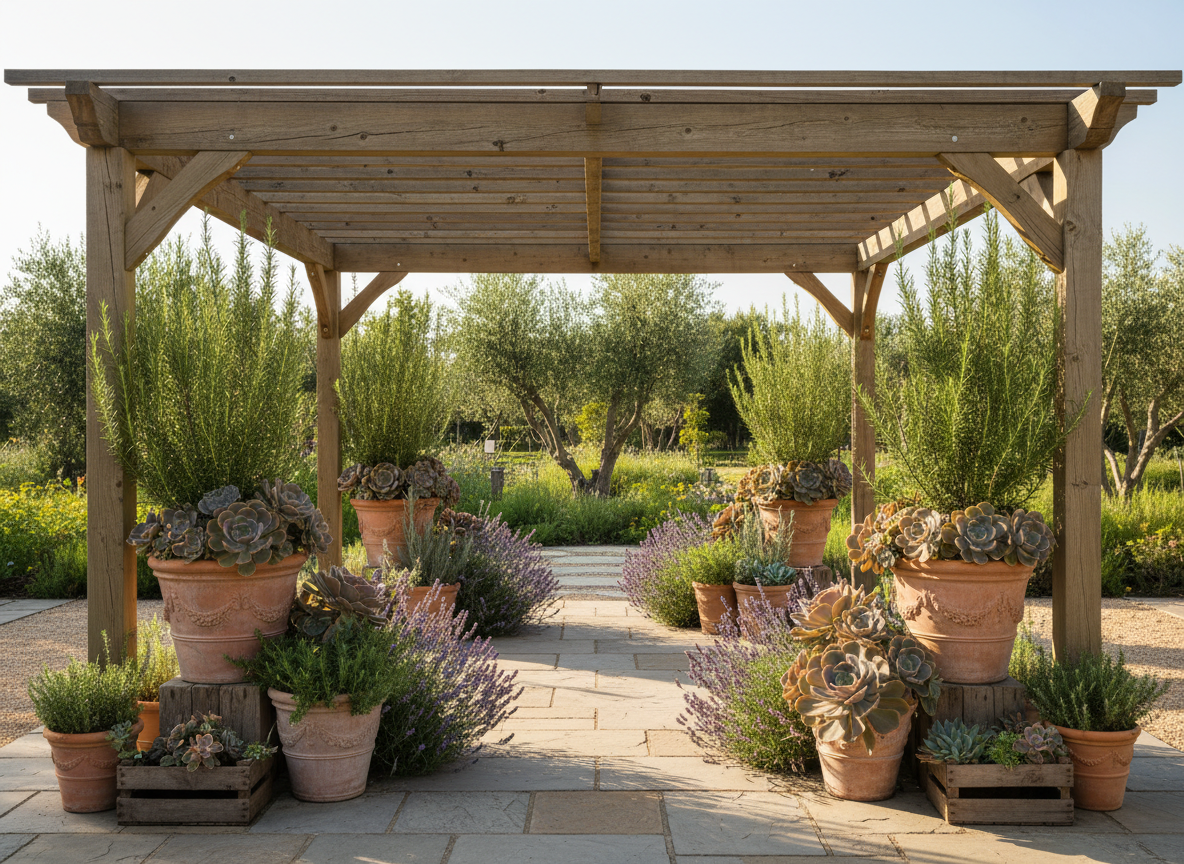
Lining the inside perimeter of a pergola with terracotta pots of Mediterranean herbs — rosemary, lavender, thyme, lemon verbena — does something that purely visual planting cannot: it makes the space smell like somewhere you want to spend hours. Brush against a rosemary shrub when you pull your chair back from the table and the air fills immediately. Set a pot of lemon verbena near a guest’s seat and conversation naturally drifts toward the scent. This sensory layer is one of the most underused tools in outdoor decorating, and it costs far less than any piece of outdoor furniture.
Terracotta is the obvious material choice — it breathes, which Mediterranean herbs prefer, and it develops a beautiful bloom of mineral deposit and soft moss over time that reads as authentically aged. Group pots in odd numbers and at varied heights using upturned pots or timber risers as platforms to add dimension. Succulents — echeveria rosettes, agave, or the dramatically dark Aeonium ‘Zwartkop’ — mix beautifully with herbs in a hot, well-drained spot and require almost no maintenance across a dry summer. The contrast of dusty grey-green succulent foliage against burnt orange terracotta and warm timber is quietly sophisticated and looks as good in August as it does in April.
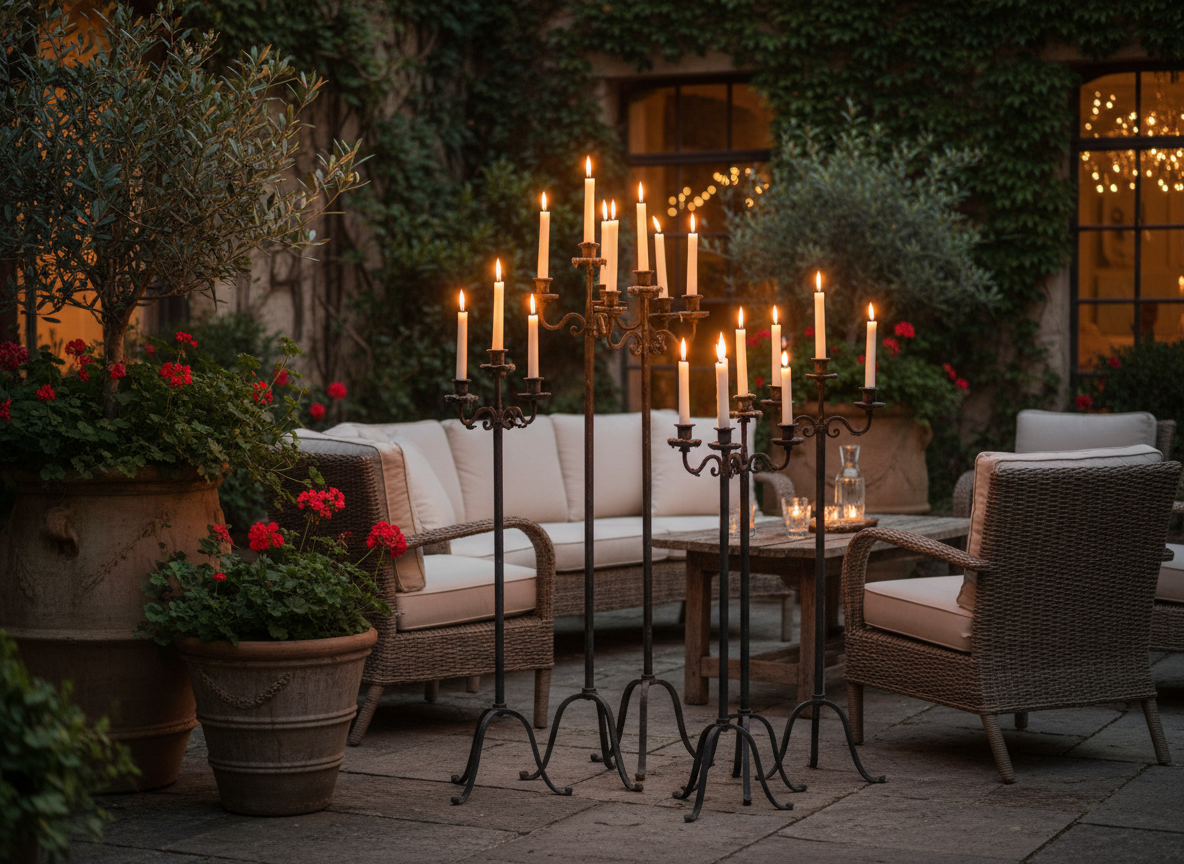
Where string lights create ambient glow, candelabras create intimacy. A cluster of wrought-iron candelabras — three or five grouped together, mixed in height — placed near the edge of the seating area produces a warm, flickering light that changes the character of an outdoor evening in a way that electric lighting simply cannot. The candle flame is alive; it moves, it responds to breath and breeze, and it bathes everyone nearby in that soft golden light that makes outdoor dining feel genuinely special rather than merely functional.
Wrought iron develops a natural rust-orange oxide patina outdoors that deepens over time, adding a European courtyard quality that painted steel never achieves. For open-air safety, choose pillar candles in wide-diameter containers or weatherproof lantern-style candelabras where the flame is sheltered from wind. High-quality LED flickering candles have improved considerably in recent years and are a sensible choice in a high-wind location where real flames struggle to stay lit. Arrange the grouping slightly asymmetrically — a pair of tall floor candelabras flanking a shorter cluster of three — to create visual depth and a sense of natural accumulation rather than a formal, symmetrical row.
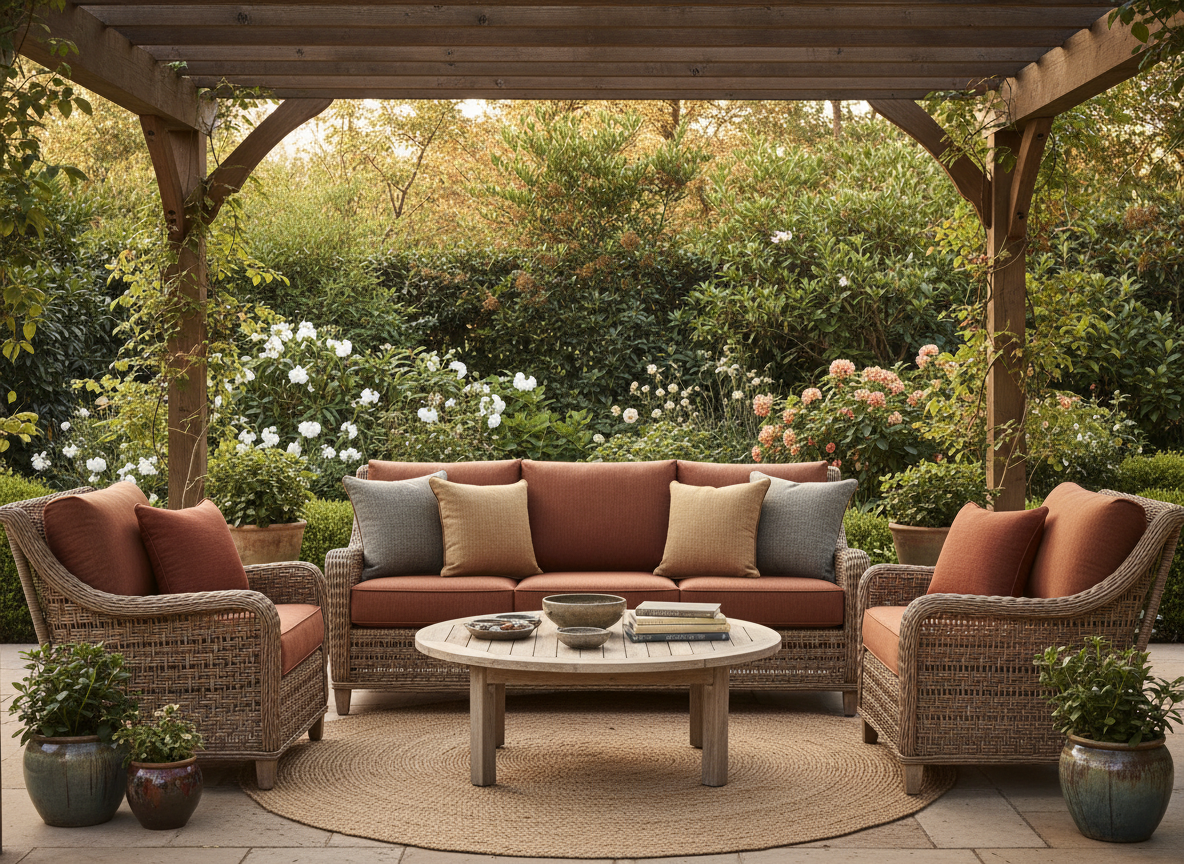
The furniture placed under a pergola determines whether the space is used for five minutes or five hours. Deep-cushioned rattan or wicker sofas and armchairs — the kind where you sink in rather than sit up — invite the unhurried conversations that outdoor living is made for. The woven material brings texture and warmth that aluminium or moulded plastic furniture lacks: the pattern absorbs light rather than reflecting it, making the whole space feel softer and more considered.
All-weather rattan — synthetic, UV-resistant PE rattan woven over an aluminium or steel frame — is the practical choice for permanent outdoor use. It handles rain without warping and sun without fading, unlike natural rattan which performs best in sheltered or covered spaces. Cushion covers in solution-dyed acrylic fabric, with Sunbrella as the widely-recognised benchmark, resist UV degradation and mould growth and maintain their colour for years rather than seasons. For colour, warm neutrals — stone, oatmeal, sand — let the surrounding garden and structural timber take the visual lead, while deep terracotta and forest green lean confidently into Mediterranean or Cottagecore territory. Size generously: the most common mistake in outdoor seating is buying too small for the space.
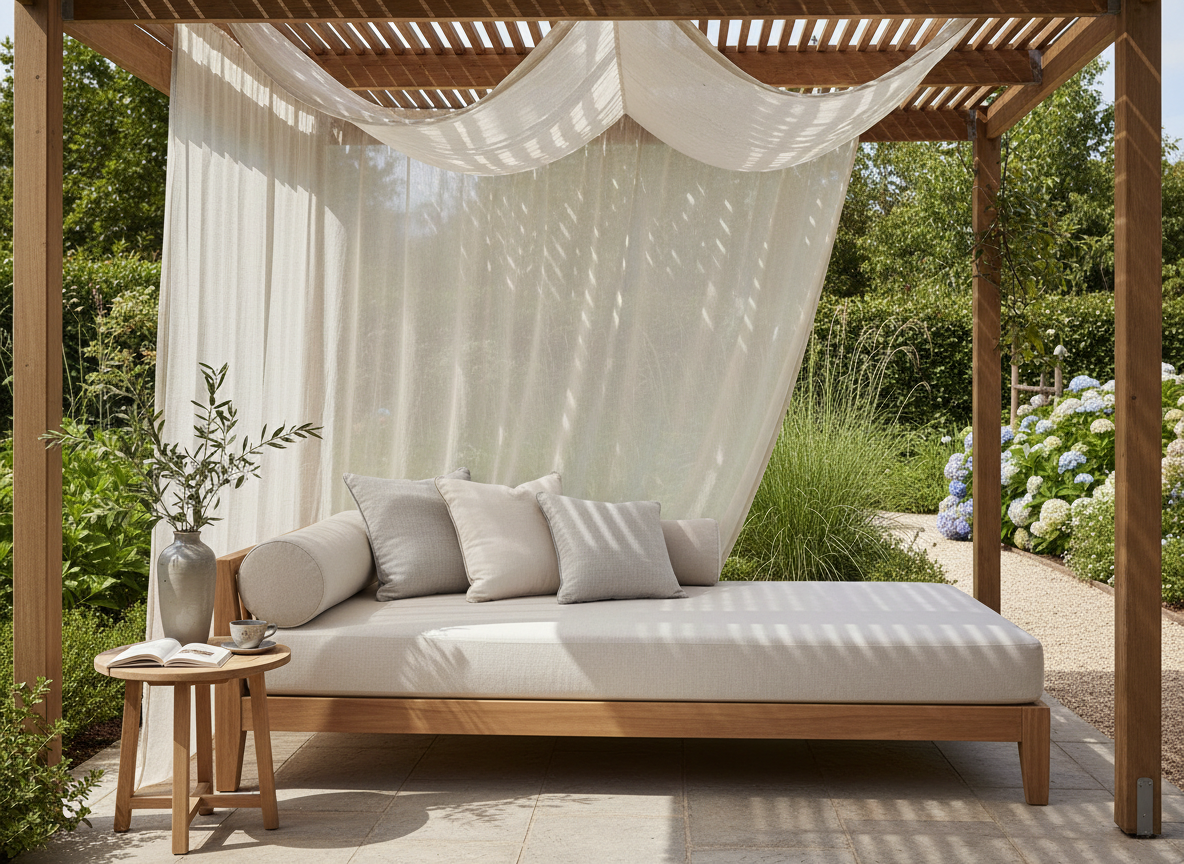
Nothing communicates leisure quite like a daybed or swing seat under a pergola — it is furniture with a single, unapologetic purpose: rest. A teak or iroko timber daybed with a thick, water-resistant mattress turns a corner of the pergola into a reading nook, an afternoon nap space, or the kind of spot children claim immediately and adults think about all week. A hanging swing seat suspended from a reinforced overhead beam achieves the same effect with added movement — the gentle swaying produces a quality of physical calm that static furniture never quite manages.
For a daybed, teak is the premium timber choice: its natural oils make it genuinely weatherproof without annual treatment, and it matures to a beautiful silver-grey if left untreated or maintains a warm honey tone when oiled every other year. The mattress should be outdoor-grade foam wrapped in weatherproof fabric, giving the appearance of a generous interior cushion while handling moisture correctly. To define the daybed corner visually within the pergola, hang a simple canopy of voile or natural linen above it, suspended from the overhead beams at two points and tied back loosely to the posts. This framing device makes the daybed feel like a destination within the destination.
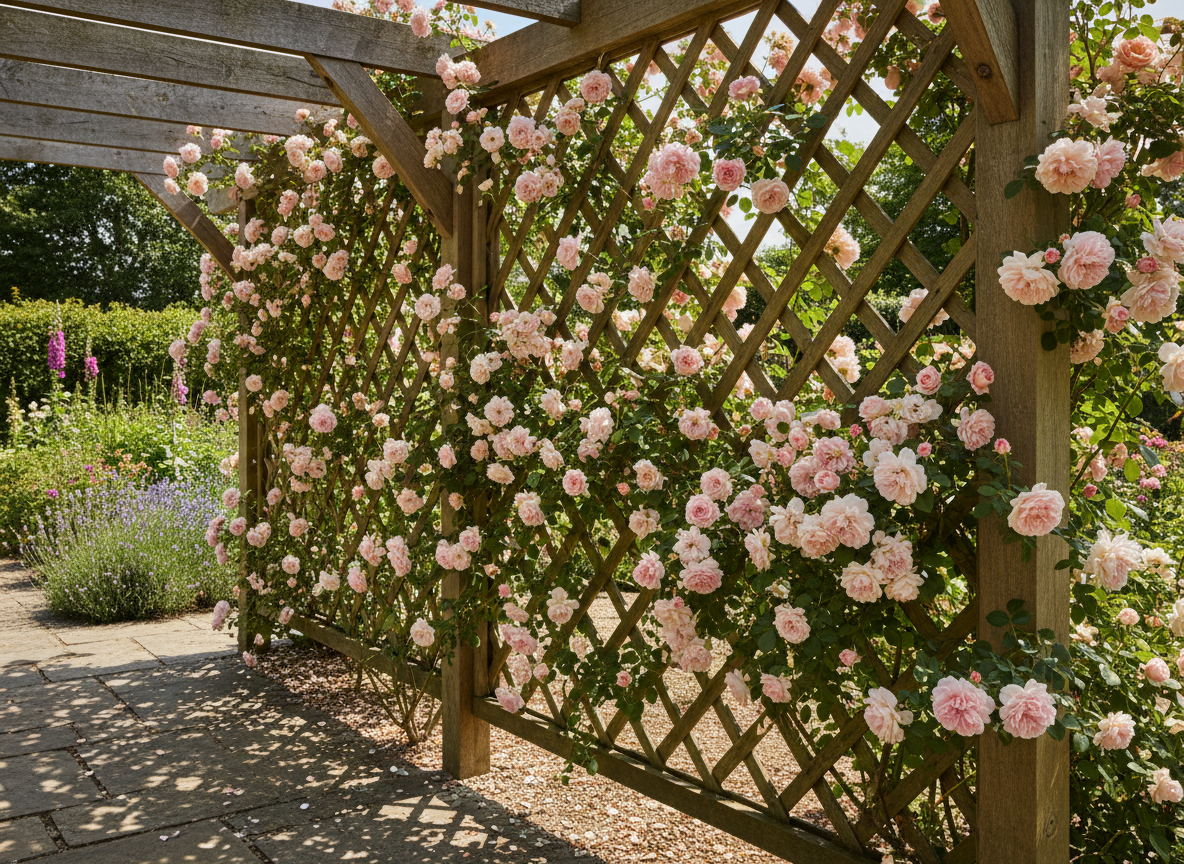
A pergola dressed in climbing roses belongs to a design tradition that spans centuries of English cottage gardens and Italian countryside estates — and the reason it recurs so consistently is that it genuinely works. A climbing rose in full summer bloom, its canes woven through timber lattice and its flowers tumbling inward and downward into the space below, creates a backdrop of such colour, texture, and fragrance that almost no other decorative addition can match it.
For pergola use, choose a climbing or rambling variety with good disease resistance and repeat flowering. ‘Gertrude Jekyll’ and ‘The Pilgrim’ (both David Austin Roses) offer repeated blooms across summer and exceptional fragrance — the former in a deep warm pink, the latter in a soft, chalice-shaped creamy yellow. ‘New Dawn’ remains the classic rambler for heavy coverage on a large structure, producing soft blush clusters in generous waves. When training the canes, fix them as horizontally as possible — this counter-intuitive approach encourages lateral growth and therefore more flowering shoots along the full length of the cane rather than just at the tip. For a cohesive outdoor aesthetic that flows from the pergola to the wider garden, pair this look with ideas from our guide to cosy outdoor porch living.
The way a dining table is dressed under a pergola determines whether the space feels like an extension of the indoors or something entirely of the garden. The distinction matters enormously. An outdoor table should be set with materials that handle the elements gracefully: heavy linen tablecloths that wrinkle attractively in the breeze, ceramic or stoneware dinnerware in earthy tones that reads beautifully under natural light, unpolished brass or matte black cutlery, and short-stemmed glasses that will not catch the wind and topple.
Solid timber tables — teak, acacia, or reclaimed oak — are the classic choice because they develop character with outdoor exposure rather than deteriorating. Powder-coated steel legs in a matte charcoal or clay finish pair well with timber tops and resist rust in all but the most exposed coastal positions. For tablescaping, keep the centrepiece low: a terracotta planter of herbs or seasonal flowers, a scatter of glass tea lights, and a folded linen napkin at each setting creates the casual but considered aesthetic associated with long Mediterranean lunches. The cumulative effect communicates something specific and welcoming: we eat here properly, outdoors, and there is no hurry at all.
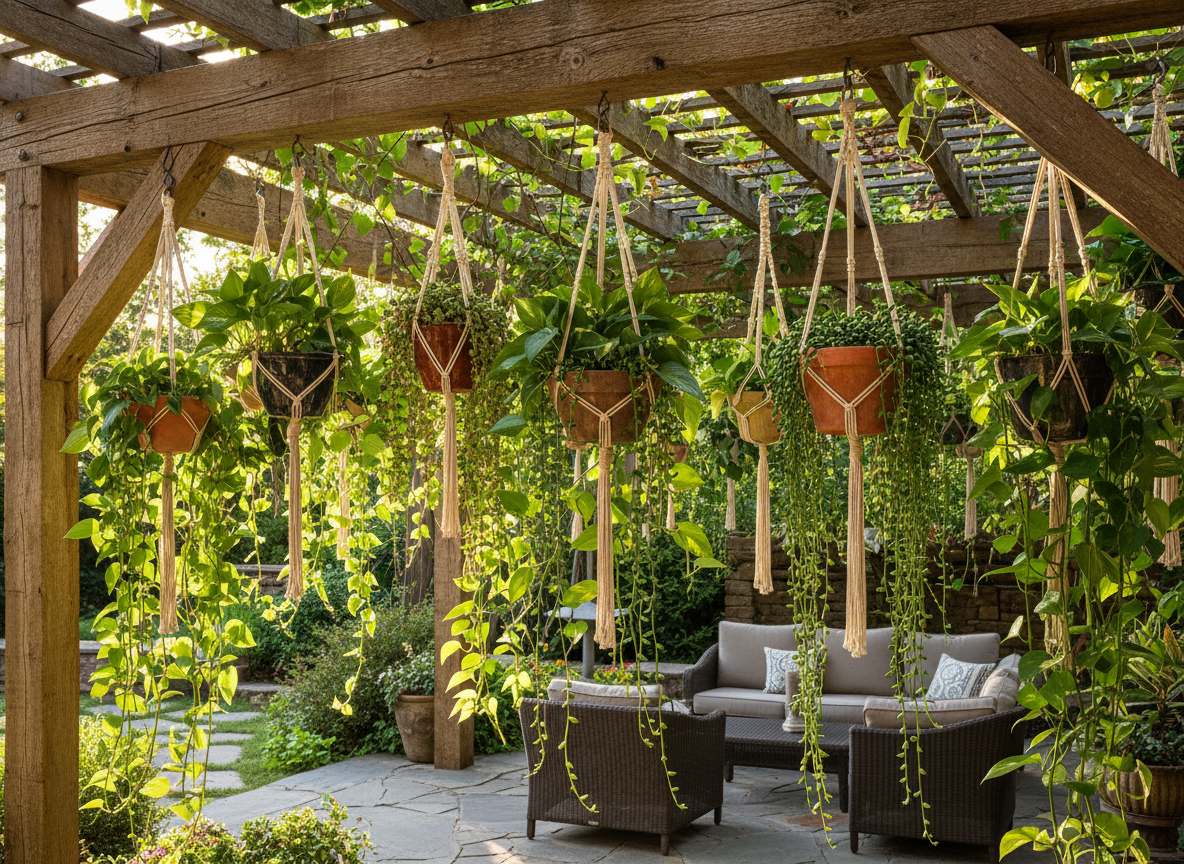
The overhead plane of a pergola — the structural beams running across the ceiling — is prime real estate for hanging planters, and most people leave it completely empty. Suspending a collection of planters at varied heights from the pergola ceiling creates a verdant canopy below the beams: trailing pothos, string-of-pearls, burro’s tail, and ivy all cascade downward in different textures and growth habits, progressively blurring the boundary between the built structure and the surrounding garden.
Use galvanised steel hooks screwed directly into solid timber beams, rated for the full weight of a planted pot including saturated compost and water after rain. Macramé hangers in natural cotton cord suit a bohemian, cottage, or coastal aesthetic well; clean black iron hooks or steel cable reads better in contemporary or industrial pergola designs. Keep the plants at varying heights — some at eye level to create enclosure, some high above to frame the sky — for depth and visual movement. Group by leaf form rather than species: round, paddle-shaped leaves mixed with fine trailing varieties creates visual contrast that individual matching species cannot. Water consistently, as overhead plants dry out faster than ground-level containers.
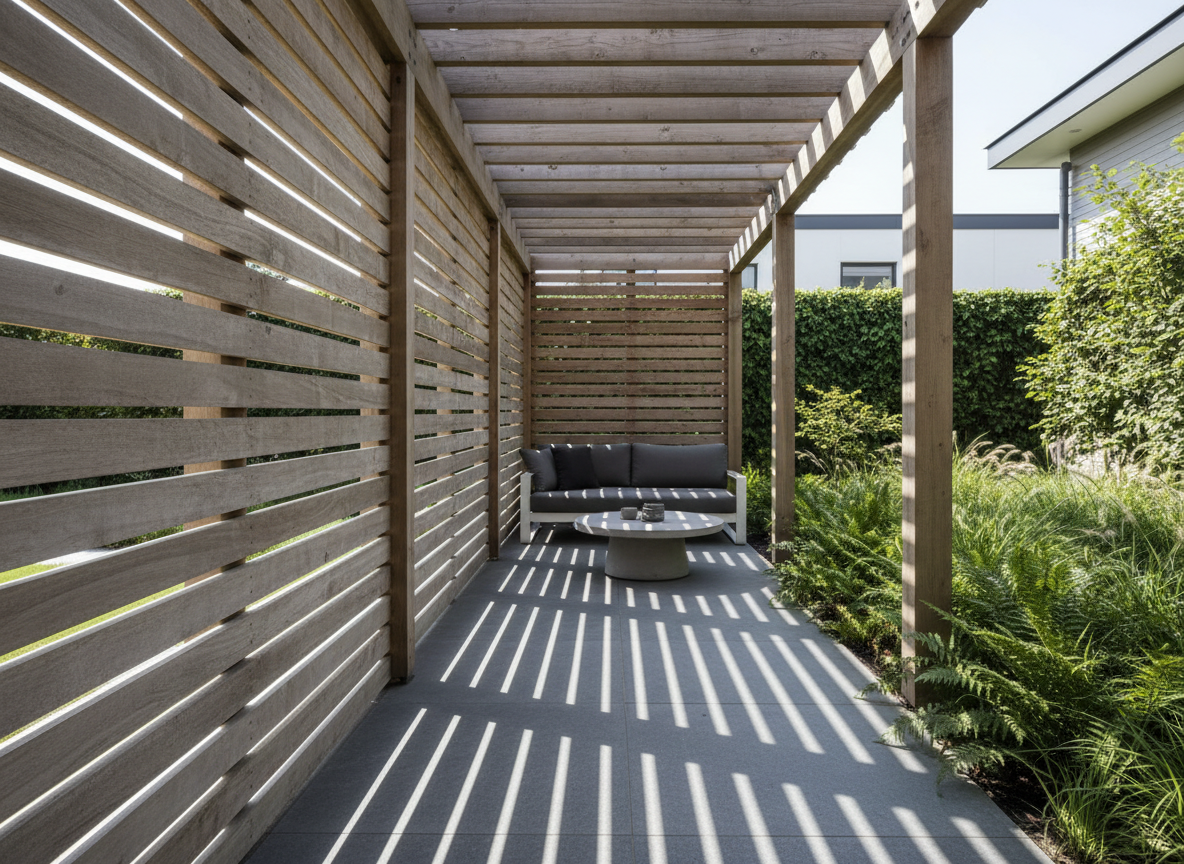
An open pergola offers shade and spatial definition, but it rarely offers privacy. Adding a timber privacy screen or batten panel along one or two sides transforms the space from a structure in the garden to a room with walls — a subtle but fundamental shift that changes how the space feels to sit in. Suddenly the seating area is shielded from a neighbouring fence, a busy driveway, or the wider sightlines of the street, and the space becomes genuinely internal-feeling, intimate, and self-contained.
Cedar and iroko are the preferred timbers for outdoor screening: both resist rot and insects without heavy preservative treatment, and both develop a slow, attractive silver-grey patina when left untreated. Battens spaced at 20 to 30mm gaps allow air to move through freely while obscuring direct sightlines from the outside. A steel mesh panel or tensioned wire trellis planted with climbing greenery achieves similar privacy with a more contemporary result. Position screens on the west side of the pergola where possible to filter late-afternoon sun, creating long, interesting striped shadows across the floor as the light passes through the batten gaps — an unexpected bonus that makes the space feel designed rather than simply built.
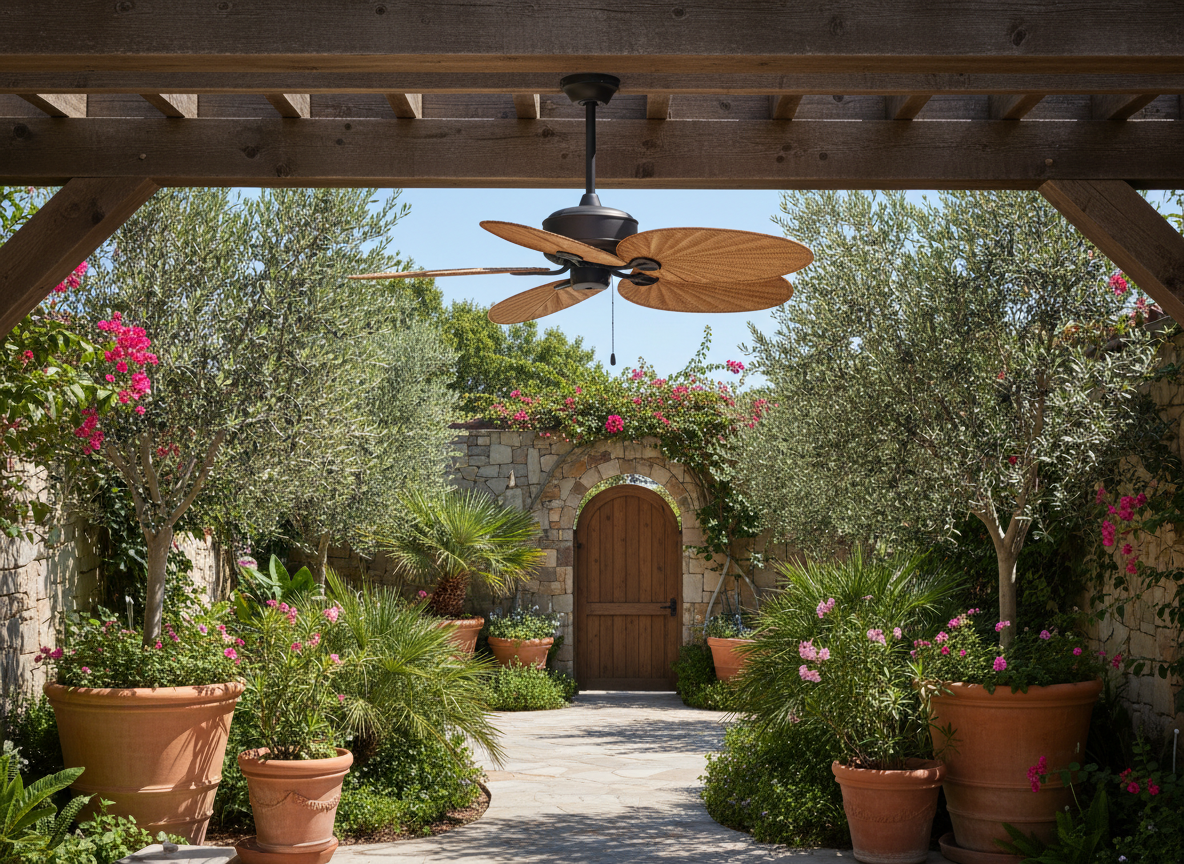
In warm climates, or through the heat of summer in temperate regions, the single most practical addition to a pergola is a ceiling fan. It addresses the one limitation of a covered outdoor space — trapped, stagnant heat — by creating a consistent, gentle air movement that makes high temperatures genuinely comfortable rather than merely endurable. A well-placed outdoor ceiling fan running on its lowest setting makes sitting under a pergola on a still, hot afternoon feel refreshing rather than oppressive.
Outdoor-rated ceiling fans (look for UL Wet or UL Damp certification depending on exposure to rain) are now available in finishes that read as deliberate design choices rather than utility additions: matte black iron, brushed bronze, natural bamboo blades, and rattan-wrapped housings all exist and suit a range of aesthetic directions. For a pergola with a solid or partially slatted roof, mount directly to a structural beam on a downrod long enough to position the blades at a minimum of seven feet above the floor — the minimum safe clearance for comfortable use. Choosing a fan with a built-in LED light fitting handles two functions from one ceiling penetration, keeping the overhead structure visually clean and uncluttered.
Cushions and scatter pillows are the fastest and most cost-effective way to pivot an outdoor space’s personality — and in a pergola, they carry double duty: physical comfort and the space’s primary source of pattern and colour. A well-chosen set of scatter cushions can define whether a pergola reads as Mediterranean casual, Japandi minimal, English cottage garden, or modern tropical. Change them seasonally and you effectively redecorate the entire space for the cost of a few cushion covers.
Material matters critically outdoors. Standard interior cushions absorb moisture, develop mildew, and fade within a single exposed season. Outdoor-rated cushion covers in solution-dyed acrylic fabric resist UV fading and water absorption — they dry within hours of rain rather than sitting damp for days and breeding mould in the filling. For a cohesive result without looking co-ordinated to the point of sterility, anchor the selection with one dominant print and two complementary solids: one that picks up a mid-tone from the print and one that introduces a contrasting accent. Overscale botanical prints — large tropical leaves, painterly florals, abstracted ferns — hold their visual weight in the open air far better than small repeat patterns, which lose definition against a busy garden backdrop.
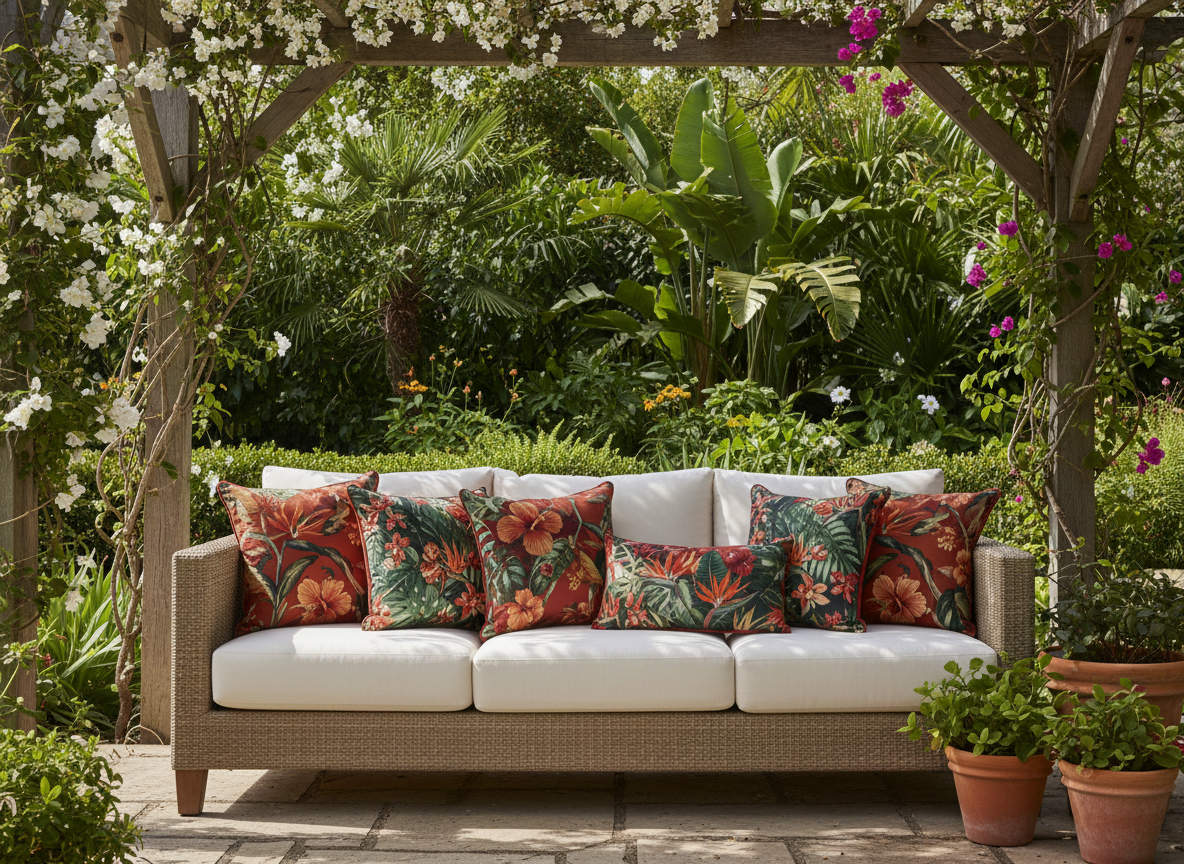
Low-level lighting provides the dimension that overhead string lights alone cannot: warmth coming up from the ground. A collection of lanterns — hammered Moroccan-style steel, clean square glass, weathered zinc, or hand-thrown ceramic — placed around the perimeter of the seating group at floor level draws the eye downward and creates a ring of ambient warmth that makes the space feel enclosed and intimate once the sun goes down.
Cluster them in odd-numbered groupings of three or five, varying heights slightly within each cluster by placing shorter lanterns on flat stones or reclaimed brick risers. Mix sizes rather than matching them exactly — three identical lanterns in a row read as a shelf display, while three graduated sizes grouped closely together look intentionally composed. Fill them with LED pillar candles for a flame-free, wind-proof glow that lasts all evening without relighting or wax management. For a layered sensory effect, position lantern clusters among terracotta pots of rosemary and lavender so that the warmth of the light is accompanied by the scent of crushed herbs rising from the pots nearby — sight and smell working together to create something that feels genuinely atmospheric.
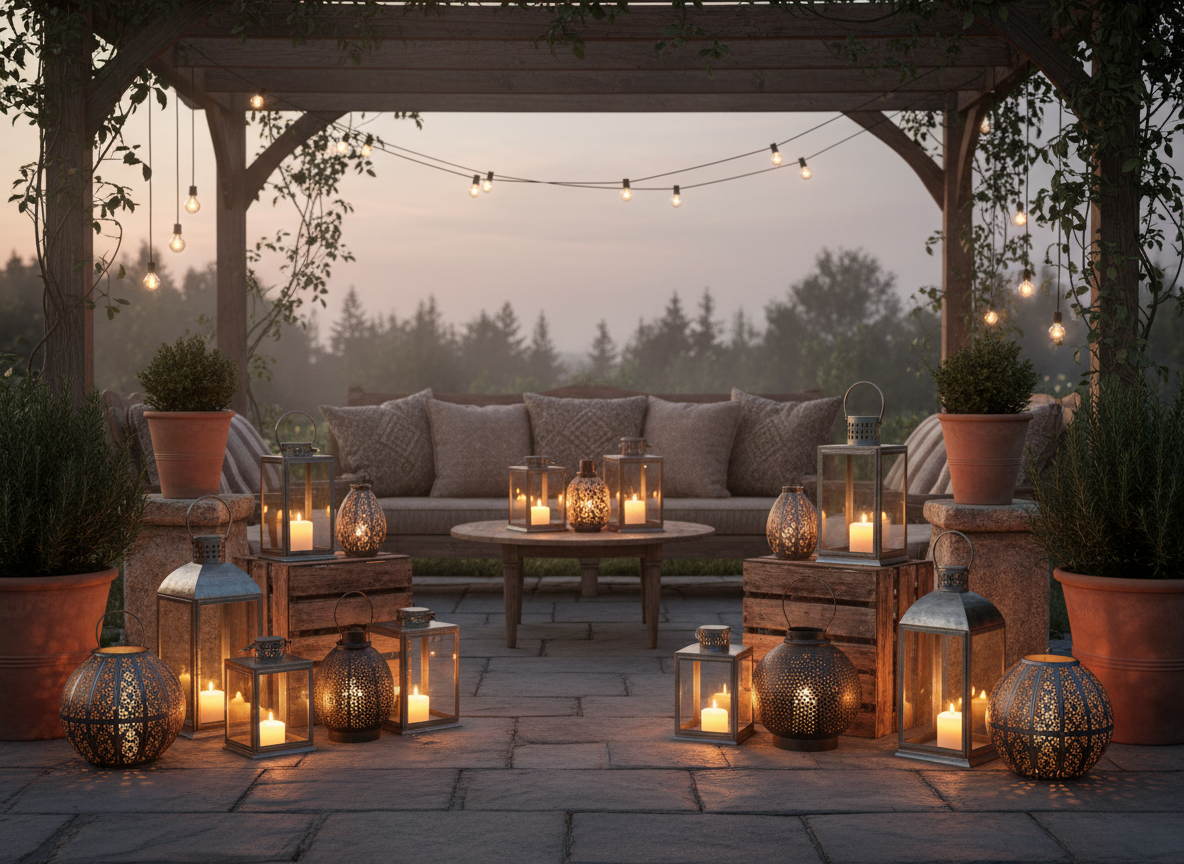
A built-in bench running the length of one side of the pergola is perhaps the most spatially intelligent permanent addition you can make to the space. It provides generous, continuous seating without the visual clutter of multiple separate chairs, and the cavity beneath can be fitted with lift-up lid storage for cushions, garden tools, outdoor blankets, or tableware. This is the kind of feature that makes a pergola feel carefully planned and architecturally resolved rather than casually furnished.
In hardwood — teak, iroko, or FSC-certified tropical hardwood — a built-in bench becomes more beautiful over time as the wood weathers and the grain deepens. In painted exterior-grade MDF or pressure-treated softwood, it reads as a cleaner, more contemporary piece when finished in an outdoor-rated colour: a deep sage, a warm off-white, or a slate blue. The seat depth should be a minimum of 500mm for comfortable lounging without a cushion, and 450mm for a more upright dining-height position. Line the interior storage cavity with a waterproof membrane and seal all joints with exterior-grade silicone to keep stored cushions dry through the wettest autumn.
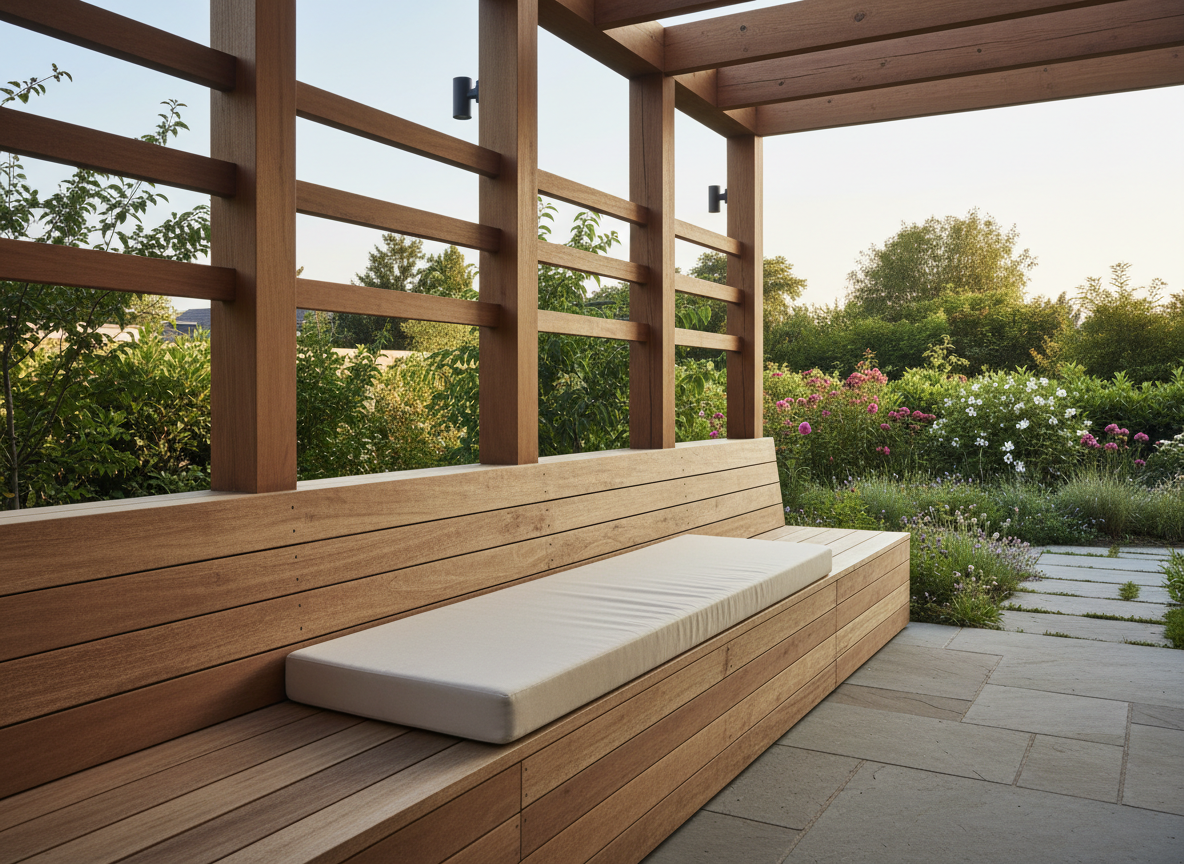
The most characterful pergola spaces almost always contain at least one element that does not match everything else — an object that introduces history, imperfection, or unexpected scale. A salvaged iron gate repurposed as a decorative panel against a side post. A collection of antique terracotta pots in graduated sizes clustered in a corner. A worn stone trough planted with sempervivums and roof-tile houseleeks. A rusted metal letter or vintage enamel sign. These recovered objects carry a patina that takes decades to develop naturally and cannot be replicated by new manufacture.
Architectural salvage yards, reclaimed materials dealers, and weekend market stalls are the best sources — and the most productive approach is browsing without a specific object in mind, looking instead for pieces that respond to what you already have in the space. The key editorial rule is restraint: one or two genuinely interesting salvaged pieces among considered contemporary choices will elevate the whole space. A dozen mismatched vintage items simply reads as clutter. A single piece of substantial, interesting salvage — say, a worn stone threshold repurposed as a low table beside the daybed — grounds the entire aesthetic with a quality of genuine age and story that no catalogue purchase can provide.
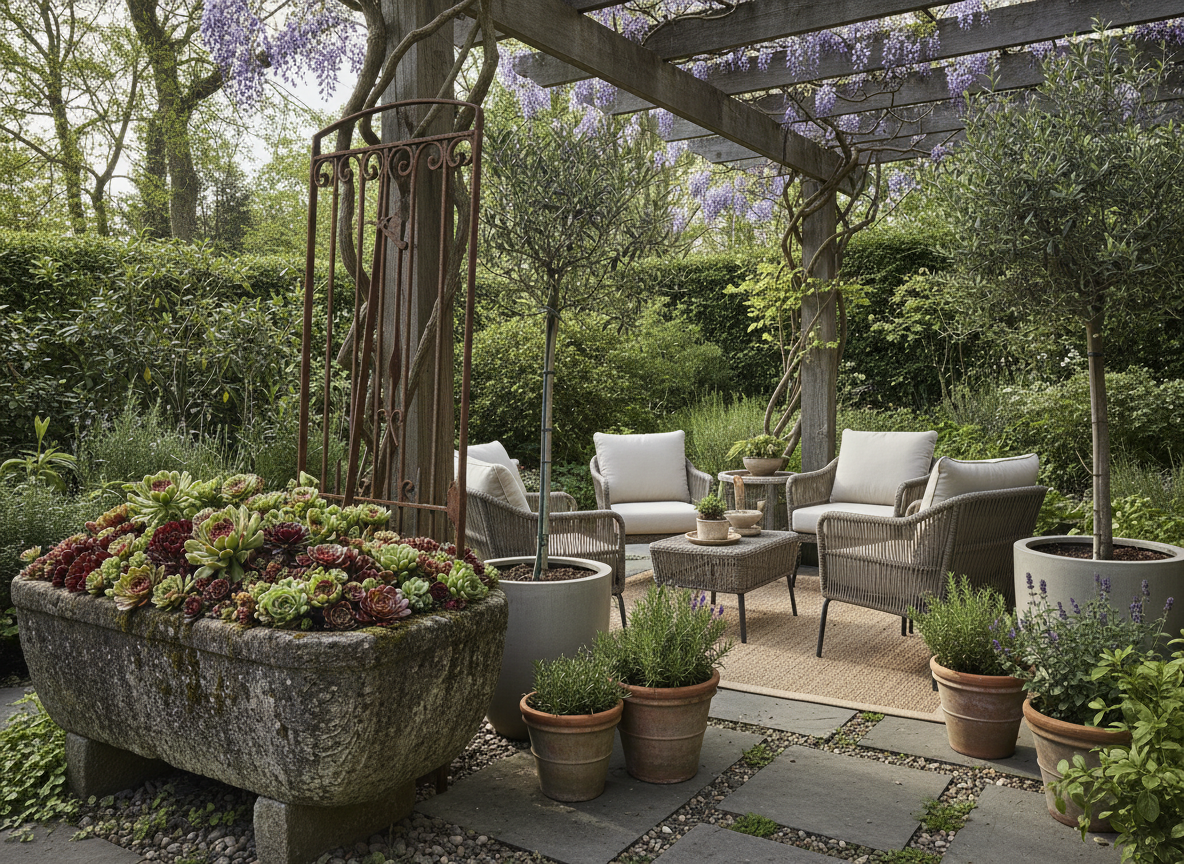
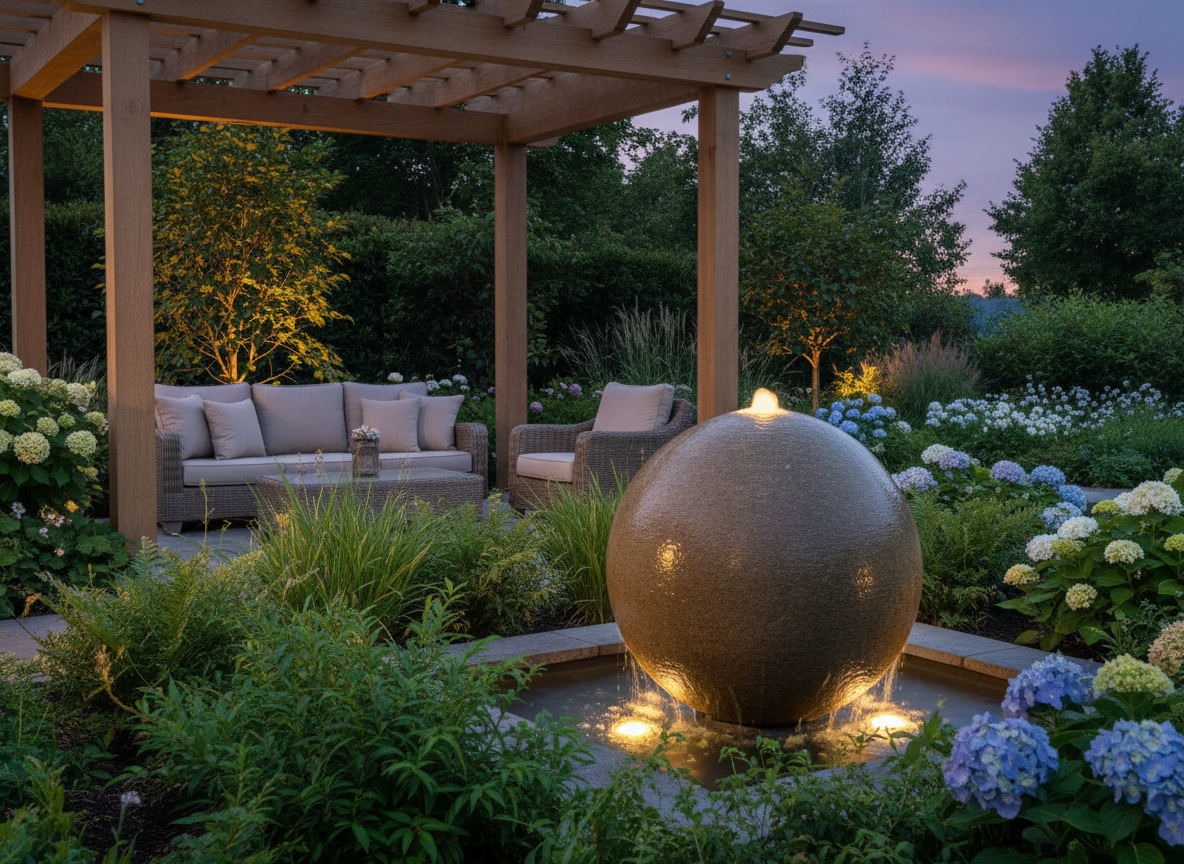
The relationship between a pergola and its immediate surroundings matters as much as what is inside the frame. Positioning a water feature — a stone basin fountain, a recirculating wall spout, a small formal rill, or a still koi pond — just beyond the open edge of the pergola creates an acoustic backdrop that fundamentally changes the character of the space. The sound of moving water covers ambient noise from streets and neighbours, subtly lowers the perceived temperature of the surrounding air, and produces a quality of calm that no decorative element inside the pergola frame can replicate.
A simple recirculating stone ball fountain on a pea gravel base costs less than a set of quality outdoor cushions and installs in an afternoon with no specialist plumbing required — just a weatherproof outdoor socket and a submersible pump. Position it on the central axis of the pergola’s open side so that it forms a deliberate visual terminus — a destination for the eye when seated inside, framed by the pergola posts like a painting. For nighttime use, a small submersible spotlight inside the basin illuminates the water in motion, casting shifting, organic reflections onto nearby foliage and the underside of the pergola beams as darkness falls.
A pergola’s potential lies almost entirely in how it is finished. The structure gives you the bones; the layering gives you the experience. The cascading string lights approach alone will reclaim your outdoor evenings, while the combination of outdoor curtains, a built-in bench, and a statement pendant creates an outdoor room that rivals any interior in comfort and intention. And if you start just one thing this weekend, make it the climbing roses or jasmine — planted now, they will reward you with seasons of slow, fragrant transformation that no piece of furniture ever will.
The best pergola spaces are not assembled all at once. They accumulate — a lantern cluster one season, a new rug the next, a daybed corner finally completed with the canopy it always needed. Start with whichever idea from this list pulls at you most strongly, live with it for a while, and then layer in the next. The outdoor space you have been meaning to create is genuinely closer than you think — and it begins with a single intention to use the frame you already have.
G2G Team
05-22-2026
Let’s Build
Contact us todayGet daily tips and tricks for making your best home.
2025 Green to Gorgeous